The Expanding Reach of Anti-Subsidy Investigations by the US against India
Author: Divya Nair, Partner
India and the United States are widely regarded as strategic partners. Their February 2025 joint statement set an ambitious target of doubling bilateral trade to USD 500 billion by 2033, with negotiations on a Bilateral Trade Agreement actively progressing at the ministerial level. Yet, despite this positive trajectory, recent US trade remedial investigations reveal a more protectionist trend, exposing Indian exporters to certain risks.
The United States Department of Commerce (Commerce) has been steadily expanding the range of Indian export sectors that it targets through anti-subsidy investigations. What began as enforcement actions in a handful of sectors has become a systematic pattern spanning industries from aquaculture to solar energy, from chemicals to consumer goods. Between 2009 and 2019, the Commerce initiated roughly one new anti-subsidy investigation against India each year. Since 2020, the pace has accelerated dramatically, with more than three new investigations annually on average and at least three new cases initiated in each of 2024, 2025 and the first half of 2026.
Why Indian schemes are under scrutiny
The major schemes coveted in nearly every US anti-subsidy investigation against India is a small cluster of government programmes: the Duty Drawback scheme, Advance Authorisation scheme, Remission of Duties and Taxes on Export Products (RoDTEP) scheme, state electricity tariff concessions, GIDC policy, Special Economic Zone benefits, export credit financing facilities, provision of natural gas, and provision of goods and services at less than adequate remuneration.
The RoDTEP scheme deserves special attention because its situation is particularly ironic. RoDTEP was designed from scratch to remit only actual embedded taxes on exported goods, a structure explicitly permitted under the WTO Agreement on Subsidies and Countervailing Measures.
The PLI scheme also faces a risk. As PLI scheme expands to new sectors, electronics, semiconductors, textiles, each expansion of the PLI scheme effectively enlarges the universe of Indian exporters that could become targets of future anti-subsidy investigations. Once Commerce develops a legal rationale for treating PLI scheme benefits as countervailable in one sector, domestic industries in other sectors are likely to rely on the same reasoning.
A New and Underappreciated Threat: Transnational Subsidies
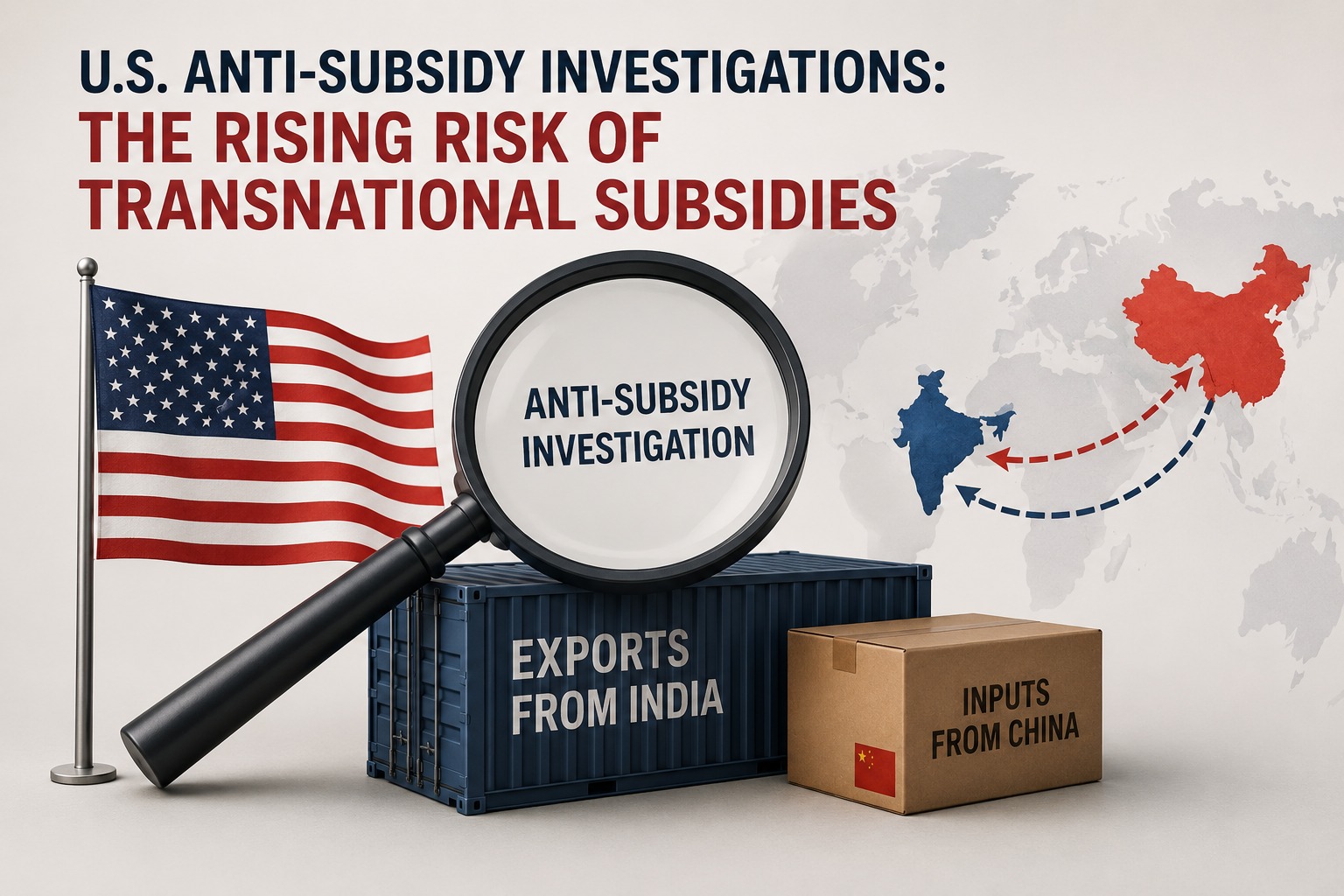
Beyond the programmes listed above, Indian exporters face an additional new threat that needs to be considered – transnational subsidy. A transnational subsidy is a financial contribution made by the government of one country that confers a benefit on a producer located in an entirely different country.
Until April 2024, Commerce was bound by 19 CFR § 351.527, which provided that a subsidy could not be found to exist if it was supplied by a government other than the government of the country in which the recipient firm was located, except in narrowly defined statutory circumstances. In 2024, Commerce amended the provision and withdrew the prohibition altogether, stating that it was “reserving it for future consideration” and citing the need to address “complexities and challenges in international trade” that had not existed, or had not existed to the same degree, when the original regulation was issued decades earlier.
Commerce is now investigating transnational subsidies under the general financial contribution and benefit provisions of the Tariff Act 1930, without any transnational-specific regulatory standard to confine how the theory is applied. The explicit motivation cited by Commerce was the Belt and Road Initiative of China, under which Chinese state-owned banks and enterprises fund manufacturing capacity in third countries, including India.
In practice, it means that an Indian manufacturer, even one that is entirely Indian-owned and Indian-funded, can potentially be subjected to a US anti-subsidy investigation that alleges Chinese subsidies, if alleged subsidised inputs are procured from China.